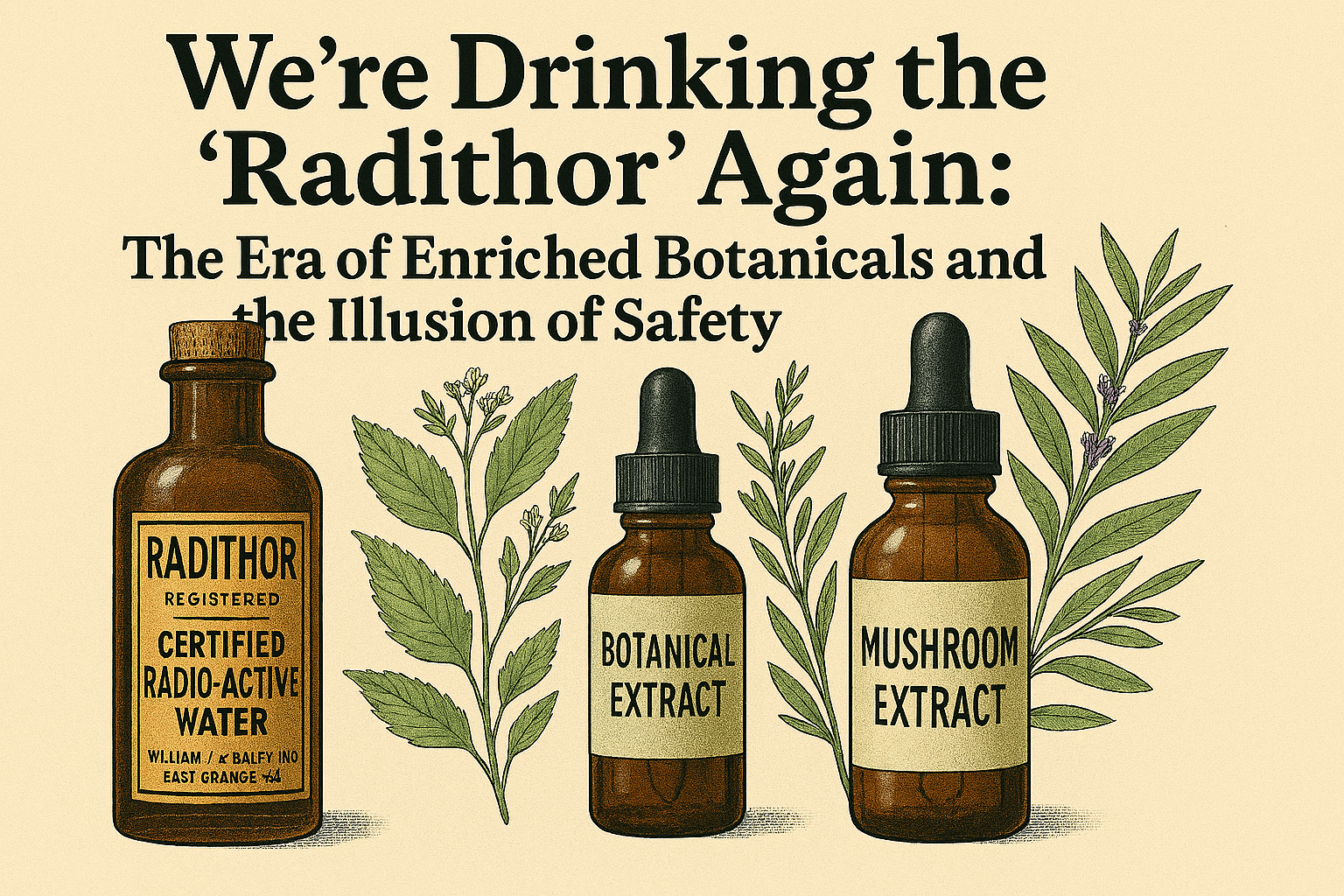
How does Uranium and modern extracts compare? There’s no way there can be any correlation, right? WRONG! Let’s unpack this together, shall we?
In 1930, they drank Radium for ‘vitality.’ Today, we swallow enriched botanicals for ‘wellness.’ We would like to explore the chilling parallels between the Uranium Craze and modern isolates like 7-OH and THC-P. Novel psychoactives that are currently being marketed—often with vibrant packaging, minimal regulation, and “miracle” health claims—mirrors the 1950s Uranium Craze (and the earlier Radium era), where the public was enamored with a powerful new energy source before the safety science caught up.
Back then, Uranium and Radium was sold in “Radithor” tonics and glowing watches; marketed as an energy-boosting cure-all for everything from arthritis to aging. Today, 7-OH and THC-P are sold in gas stations and “smoke shops” as hyper-potent extracts; marketed for pain, focus, and euphoria with little long-term clinical data.
Today, “natural” is a fallacy. Just as Uranium was a “natural element from the earth,” Kratom and 7-Hydroxymitragynine (7-OH) are marketed as plant-based alternatives, often bypassing the scrutiny applied to synthetic pharmaceuticals. The DSHEA Act of 1994 creates a “gray market” for these products, like how early 1900s patent medicines operated before the FDA had real teeth in the matter.
Both eras involve delayed reckoning. With Uranium, the damage was often cellular and invisible until it was too late; with modern synthetics and isolates (like 7-OH and high-potency THC), the “radiation” is neurological and systemic.
Here is how we can mirror the long-term effects of the Atomic Age with the modern “Alkaloid Age”:
The “Slow Burn”: Comparing Long-Term Consequences
| The Uranium/Radium Era | The Modern 7-OH / THC / Kratom Craze | The Shared Underlying Issue |
| Bone Necrosis (“Radium Jaw”): Radium mimicked calcium and settled in the bones, destroying them from the inside over years. | Receptor Downregulation: Chronic high-potency 7-OH or THC “burns out” opioid or cannabinoid receptors, potentially altering brain chemistry permanently. | Molecular Mimicry: The body mistakes a dangerous external substance for a natural internal building block or signal. |
| Genetic Mutation: Long-term exposure led to cancers and cellular mutations that didn’t appear for a decade. | Endocrine & Liver Stress: We are seeing early signs of hormonal disruption (hypogonadism) and unexplained liver toxicity from concentrated extracts. | The Latency Period: The “poison” is cumulative; the user feels fine (or even “supercharged”) until a threshold is crossed. |
| The “Radiant” Glow: Users initially felt a surge of energy and health, masking the underlying decay. | The “Natural” High: Users feel they are using a “safe” plant extract, masking the development of severe physical dependence and withdrawal. | The Illusion of Vitality: The initial benefits act as a screen, preventing the user from noticing long-term degradation. |

Deep Diving the Comparison
Just as a site becomes “hot” with radiation and requires more and more shielding, the human brain becomes “hot” with these isolates. In the long term, the user isn’t chasing a high anymore; they are simply trying to manage the “fallout” (withdrawal) of their own altered neurobiology. The Uranium craze turned deadly when scientists learned to isolate the most active isotopes. Raw Kratom leaf or low-potency flower is like the ore; 7-OH and THC-P are the enriched fuel. We can argue that the human body has not evolved to handle “enriched” alkaloids any more than the Radium Girls had evolved to handle pure radium paint. Uranium caused systemic organ failure. We are starting to see “CHS” (Cannabinoid Hyperemesis Syndrome) in high-potency THC users and severe gastrointestinal/adrenal issues in 7-OH users—conditions that didn’t exist when these substances were consumed in their traditional, low-potency forms.
In 1920, they drank ‘Liquid Sunshine’ (Radium water) until their bones were crumbled. In 2024, we swallow ‘Liquid Gold’ (7-OH extracts) until our receptors quit. The labels have changed, but the hubris of consuming unstudied power remains the same. Uranium was safe enough when it was just a trace element in the ground. It became a “craze” (and a killer) when we concentrated it into pins, tonics, and paints. Kratom and Cannabis have been used for centuries as whole plants. The “modern craze” mirrors the Uranium era because we are now isolating the most volatile parts (7-OH and THC-P); creating a product the human body was never meant to process in such high “radioactive” concentrations.
In 1932, the death of socialite Eben Byers became the ‘shot heard ’round the world’ for the Atomic Age. After consuming over 1,400 bottles of Radithor—a popular radium-infused tonic—his bones literally disintegrated; the ‘Liquid Sunshine’ he drank for vitality resulted in his jaw having to be surgically removed before his gruesome death. Today, we are seeing a digital-age echo of the Byers tragedy. While modern users aren’t losing their jaws to necrosis, they are losing their neurological ‘architecture’ to 7-OH and ultra-potent THC isolates. Much like Byers, who was convinced by flashy marketing that he was consuming the pinnacle of science, modern consumers are swallowing neon-packaged ‘liquid gold’ shots that offer a temporary glow of euphoria while silently dismantling their natural opioid and cannabinoid receptors. We have traded the physical decay of the 1930s for a new kind of cellular fallout: a systemic, chemical dependency so profound that the ‘remedy’ eventually becomes the very thing that hollows out the user.”
We’re watching the same movie, just with different chemicals and better graphic design.
The most terrifying similarity between the Atomic Age and the Alkaloid Age isn’t the chemistry—it’s the silence of the law. In 1930, the government watched Radithor fly off shelves because it didn’t fit the ‘legal definition’ of poison. Today, we are reliving that bureaucratic paralysis. Under the DSHEA ‘Dietary Supplement’ loophole, modern manufacturers can isolate the most volatile parts of a plant, slap a ‘Not for Human Consumption’ or ‘Lab Tested’ sticker on it, and sell it in the same aisle as protein bars. We are currently living in the ’Regulatory Half-Life’—that dangerous window of time where a substance is potent enough to ruin lives, but the law is too slow to catch the fallout. Just as it took the gruesome death of Eben Byers to give the FDA ‘teeth’ in 1938, one has to wonder: what will be the ‘7-OH moment’ that finally forces the law to bridge the gap between ‘natural’ and ‘narcotic’?”
Just as Radium products were “Certified Radioactive” (which sounded like a good thing then), modern shots brag about “Third-Party Labs.” But as Consumer Reports has noted, those labs often only check for heavy metals, not for the neurological payload of the isolate itself. The word “Natural” is used as a legal bulletproof vest. If it comes from a plant (Kratom or Hemp), the public assumes a level of safety that the National Institutes of Health (NIH) warns is simply not guaranteed once you isolate the chemicals.
In the 1900s, people didn’t get addicted to “uranium ore”; they got sick from concentrated radium. Traditional Kratom leaf has a “ceiling effect” (you get sick before you get too high). 7-Hydroxymitragynine (7-OH) isolates strips that ceiling away. By bypassing the plant’s natural buffers, the substance hits the brain’s -opioid receptors with surgical precision. For a developing brain (under 25), this can “rewire” the reward circuitry faster than the user can develop a conscious awareness of the habit. Because there is no “smoke” or “smell,” youth can dose 50–100 times a day (in class, at home, in bed). This constant “re-dosing” prevents the brain from ever returning to baseline, making physical dependency almost inevitable.
In the 1940s, children played with ”Gilbert U-238 Atomic Energy Labs” (actual toys with radioactive ore). Today, we have “Delta-8 Gummies” that look exactly like Nerds Rope or Sour Patch Kids.
The result? When a substance is packaged as a “treat,” the brain’s “danger” response is silenced. By the time the youth realize it’s a powerful narcotic isolate, the physical “fallout” (withdrawal) has already set in. You wouldn’t let Radithor take your jaw, so why would you allow 7-OH or THC-P to take away your mental and emotional security?
Natural” doesn’t mean “neutral” and ”purity” is often just another word for “potency.