Have you ever had one of those days where something goes wrong, and before you know it, you’re thinking about everything else that is going wrong too?
Maybe you make a mistake at work and immediately think, “I’m such a failure.” Or you have an argument with someone you care about and start thinking, “This relationship is never going to work.” When stress starts building, you might even find yourself thinking, “I can’t deal with this unless I use.”
Thoughts like these can happen quickly, sometimes before we even realize what we’re telling ourselves. In cognitive behavioral therapy (CBT), these patterns are often referred to as cognitive distortions.
Cognitive distortions can affect anyone, but they can be especially important to recognize during recovery from substance use. The way we interpret a difficult situation can affect how we feel, and those feelings can influence what we do next.
What Are Cognitive Distortions?
Cognitive distortions are patterns of thinking that are often unrealistic, overly negative, or based on assumptions rather than facts. They usually happen automatically.
For example, imagine that you have an argument with your spouse.
The situation is the argument itself. But then you might think, “This relationship is hopeless.” That thought can lead to feelings of anger, sadness, or defeat. Those feelings might then lead to an urge to escape or numb yourself, possibly through alcohol or drugs.
It can help to think about the process this way:
Situation → Thought → Feeling → Behavior
The situation matters, but so does the meaning we give to that situation.
Two people can go through a similar experience and respond very differently because they interpret what happened in different ways.
Why Cognitive Distortions Matter in Recovery
Recovery can come with a lot of difficult emotions. Stress, guilt, shame, anxiety, loneliness, and frustration are common experiences. When those feelings are combined with negative or distorted thinking, they can become even harder to manage.
Someone might think:
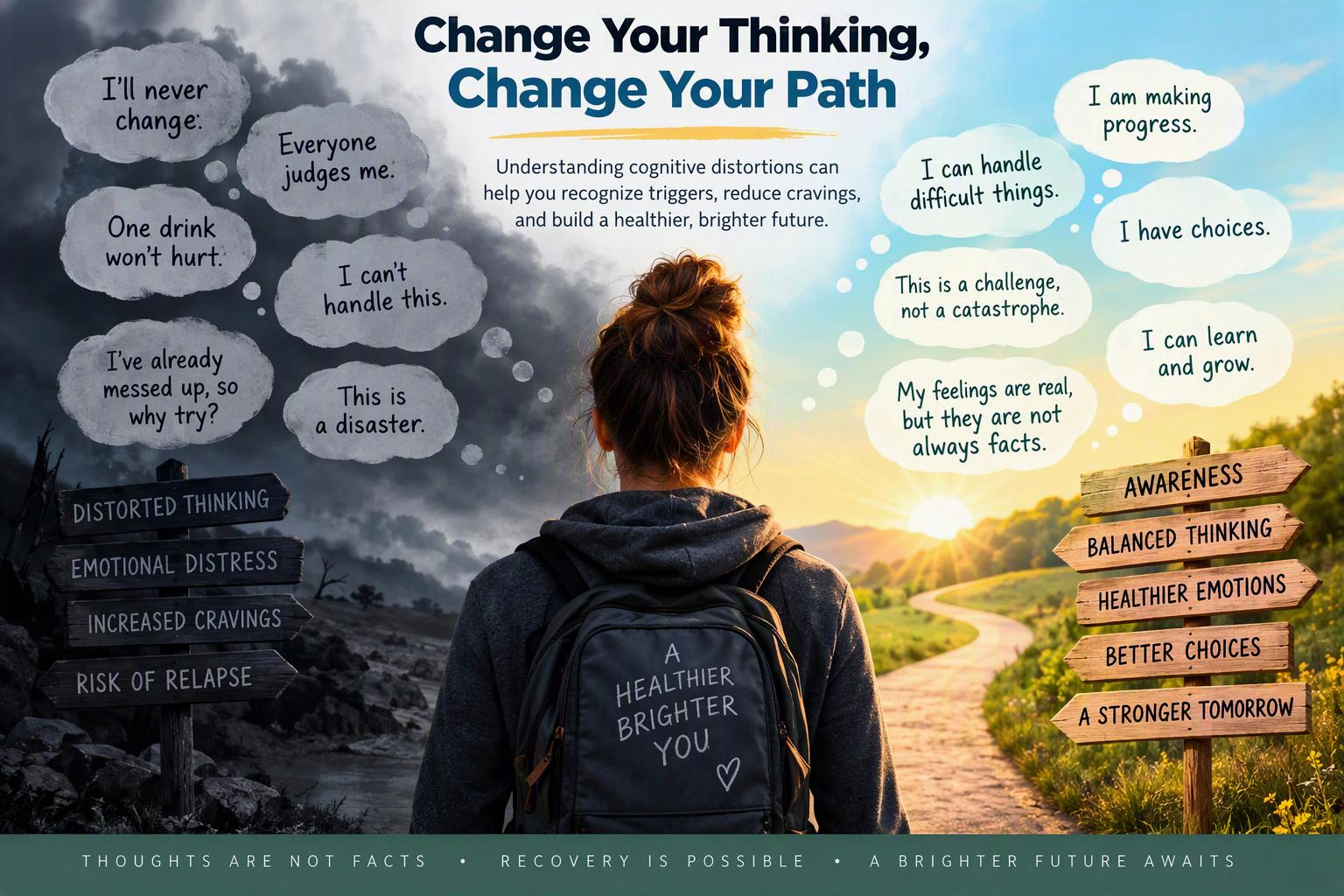
- “I’m never going to change.”
- “One drink won’t hurt.”
- “Nobody really cares about me.”
- “I’ve already messed everything up, so what’s the point?”
- “I can’t handle this without using.”
When thoughts like these feel true, using a substance can start to seem like the easiest way to get some relief.
The problem is that alcohol or drugs may temporarily change how a person feels, but they don’t actually resolve the situation that caused the distress. In many cases, using creates new problems, which can lead to even more guilt, shame, and negative thinking.
That can turn into a cycle that is difficult to break.
Common Cognitive Distortions That Can Contribute to Substance Use
1. All-or-Nothing Thinking
All-or-nothing thinking means seeing things as either a complete success or a complete failure, with very little room in between.
For example:
“If I can’t do recovery perfectly, I’m failing.”
Or:
“I missed one meeting, so obviously this isn’t working.”
A setback can then feel much bigger than it really is. Someone may decide that they’ve already ruined their progress and there is no reason to keep trying.
A more balanced way to look at it might be:
“I had a setback, but that doesn’t erase the progress I’ve already made.”
Recovery doesn’t have to be perfect to be meaningful.
2. Catastrophizing
Catastrophizing happens when we automatically assume that the worst possible outcome is going to happen.
Someone who is struggling at work might think:
“If I lose this job, my entire life is going to fall apart.”
Or someone worried about their past substance use might think:
“If people find out, nobody will ever respect me again.”
When everything feels like a disaster, using can seem like a way to escape the situation rather than deal with it.
A more realistic thought might be:
“This could be a difficult situation, but losing a job or making a mistake doesn’t mean my entire life is over. I can figure out what to do next.”
3. Overgeneralization
Overgeneralization is when one negative experience gets turned into a conclusion about everything.
For example:
“I relapsed once, so I’ll always relapse.”
Or:
“That person rejected me, so nobody wants me around.”
One experience can feel like proof that the same thing will happen again, even though there is no way to know that.
A healthier perspective would be:
“That experience was difficult, but it doesn’t determine what will happen in the future.”
A mistake or setback is something that happened. It doesn’t have to become a prediction about the rest of your life.
4. Mind Reading
Mind reading is when we assume we know what another person is thinking without actually having evidence.
For example:
“Everyone in the group probably thinks I’m a loser.”
Or:
“My family doesn’t want me around anymore.”
The problem is that we can’t actually know what another person is thinking unless they tell us.
Feeling judged or rejected can also lead someone to isolate themselves. Isolation can make difficult emotions stronger and may increase the temptation to return to old coping behaviors.
A more balanced thought might be:
“I don’t know what they’re thinking. I’m making an assumption.”
Sometimes that simple reminder can take some of the power out of the thought.
5. Emotional Reasoning
Emotional reasoning happens when we treat our feelings as if they are proof of what is true.
For example:
“I feel hopeless, so there must be no hope.”
Or:
“I feel guilty, so I must be a terrible person.”
Feelings are important, but they aren’t always an accurate description of reality.
You can feel hopeless and still have options. You can feel guilty without being a bad person.
A more balanced thought might be:
“I’m feeling hopeless right now, but feelings can change. I don’t have to make a permanent decision based on how I feel in this moment.”
6. Labeling Yourself
Labeling is different from recognizing that you’ve made a mistake. Instead of focusing on a specific behavior, you turn the behavior into a judgment about who you are.
For example:
“I’m an addict, so I’ll never be successful.”
Or:
“I’m worthless.”
These kinds of statements can create a lot of shame. Once someone starts seeing themselves as fundamentally broken or incapable of change, it becomes harder to believe that recovery is possible.
A more balanced way of looking at it might be:
“I’ve made mistakes and struggled with substance use, but those things don’t define everything about me.”
A person’s past is part of their story, but it doesn’t have to be the entire story.
7. “Should” Statements
“Should” statements happen when we create rigid expectations about how we or other people are supposed to behave.
For example:
“I shouldn’t still be struggling with this.”
Or:
“Recovery should be easier by now.”
When reality doesn’t match those expectations, it’s easy to become frustrated or discouraged.
Recovery is rarely a straight line. People have difficult days. They have setbacks. They learn things about themselves that they didn’t expect to learn.
Instead of saying:
“I shouldn’t be struggling.”
You might try:
“I’m having a difficult time right now, and I can figure out what I need to get through it.”
How Distorted Thinking Can Become a Relapse Cycle
Consider a situation where someone receives criticism from their supervisor.
The criticism itself may be uncomfortable, but the person’s reaction can depend heavily on what they tell themselves about it.
They might immediately think:
“I can’t do anything right.”
That thought can lead to shame and anxiety. Their body may respond with tension, racing thoughts, or a strong feeling of stress. They may then start craving alcohol or drugs because they want the uncomfortable feelings to stop.
The cycle might look something like this:
Criticism → “I can’t do anything right” → Shame and anxiety → Desire to escape → Craving → Increased risk of using
The criticism didn’t automatically cause the craving. The person’s interpretation of the criticism helped intensify the emotional reaction.
This is one of the reasons CBT focuses on identifying thoughts and patterns before they turn into behaviors.
How CBT Can Help
CBT doesn’t ask people to pretend that everything is fine or to replace every negative thought with a positive one.
Instead, it encourages people to slow down and ask whether their thoughts are actually fair and accurate.
When a strong thought comes up, it can help to ask:
- What evidence do I have that this is true?
- Is there evidence that doesn’t support this thought?
- Am I assuming the worst?
- Am I treating a feeling like a fact?
- Am I making assumptions about what someone else thinks?
- Is there another way I could look at this situation?
- What would I say to a friend who was thinking this way?
- Is this a fact, or is it my interpretation of what happened?
The goal isn’t to convince yourself that everything is okay when it isn’t. The goal is to develop a more realistic view of what’s happening.
A Simple Exercise to Try During a Craving
The next time you notice a strong craving, take a few minutes to work through what is happening.
Step 1: What happened?
Write down the situation that occurred just before the craving.
Step 2: What went through your mind?
Try to identify the first automatic thought you had.
For example:
“I can’t deal with this.”
Step 3: What were you feeling?
Were you angry? Embarrassed? Lonely? Anxious? Ashamed? Overwhelmed?
Try to name the emotion rather than simply saying you “felt bad.”
Step 4: What kind of thinking was involved?
Look at the thought and see whether you recognize a cognitive distortion.
Maybe you were catastrophizing, thinking in all-or-nothing terms, assuming what someone else was thinking, or judging yourself harshly.
Step 5: Is there a more balanced way to look at it?
You don’t have to come up with an overly positive statement.
Instead, try to make the thought more realistic.
For example:
“This is really stressful, but I don’t have to use to get through it. I can deal with one part of the problem at a time.”
Step 6: Check the craving again
After looking at the situation differently, ask yourself whether the intensity of the craving has changed.
It may not disappear completely, and that’s okay. The goal isn’t necessarily to make the craving vanish. The goal is to create enough space between the thought and the behavior to make a different choice possible.
Final Thoughts
Cognitive distortions are something most people experience from time to time. Having a negative or unrealistic thought doesn’t mean that something is wrong with you.
What matters is learning to recognize these patterns and noticing what happens after they show up.
During recovery, this can be especially important. A stressful situation can lead to a negative thought, which can create difficult emotions and eventually increase the desire to use. Learning to interrupt that process can give someone another option.
CBT can help people recognize those automatic thoughts, question them, and develop more balanced ways of looking at difficult situations. With practice, this can make it easier to manage emotions and respond to stress without automatically turning to substances.
Recovery doesn’t mean you’ll never have negative thoughts, cravings, or difficult days. It means learning how to respond to those experiences without letting them make the decisions for you.
Sometimes the most important step is simply being able to stop and ask:
“Is this really what is happening, or is this what my mind is telling me is happening?”
Leave a Reply